New — Claude Co-Work for Business Professionals is now free. Build your AI workflow in one afternoon. Get free access →

For Connected Products Leaders

You upgraded the engine with AI.
You haven't touched the rest of the car.

Your AI spend is working against you. Engineers are faster, the bill is going up — and the revenue line hasn't moved. The reason is structural.

$320M
Annual product revenue built & scaled
50M+
Active connected devices managed
$530M
Product ecosystem revenue supported
25 yrs
Engineering leadership, connected products
The Problem

Fast engineers. Flat revenue. The reason no one names.

"We've had Copilot and Cursor for eight months. The board wants to know why it's not in the ARR."

Your engineers are faster. The AI bill is higher. The revenue line hasn't followed. The operating model that decides what your faster engineers build hasn't changed — and that's the part AI can't fix on its own.

See how we fix this

"Product says engineering can't commit. Engineering says product can't define. Both are right."

The blame loop is not a people problem. It's the ownership gap — the hard line between product and engineering where product owns the what and engineering owns the how. That gap was tolerable when coding was slow. AI made it catastrophically expensive to leave in place.

See how we fix this

"We added headcount, bought the tools, ran the reorg. The roadmap is still slipping."

In connected products, this runs three directions at once — hardware, firmware, and cloud each operating on separate schedules with no shared model for what to build. AI made each layer faster at building the wrong thing. The constraint isn't people or tools. It's the structure that governs decisions.

See how we fix this
How We Work

Ground Truth. Decisions. Numbers.

Every engagement runs the same method: the Velocity Workshop diagnoses the structural gap and installs a working baseline. The Joint Operating Model is the framework — closing the ownership gap between product and engineering and aligning priorities through the Prioritization Framework. Advisory and Implementation sustain and compound what the Workshop starts.

Ground truth before recommendations. Decisions made in the room. Measurable outcomes every month — not slide decks.

20–40% Cycle Time Reduction
01 — Ground Truth First

Stakeholder interviews and audits

No assumptions, no installed-and-hope deployments. We surface objectives, blockers, and the real cost of your current AI tooling before recommending a thing.

02 — Decisions, Not Slides

Working sessions in the room

Workshops produce decisions you can act on — not slide decks. Working sessions using the Prioritization Framework, with a punch list and a 6-month roadmap.

03 — Numbers Every Month

Measurable outcomes, ongoing

Whether you're on month-to-month Advisory or a full Retainer, every engagement reports against the roadmap. What improved, what stalled, where the next opportunity lives.

Graham Hardy
25+ Years in Engineering & Product Leadership
Velocity Services

25 Years Building Connected Products Organizations

25 years on the operator side — not the consulting side — at every level from engineering trenches to P&L. I built OvrC from zero to 50M+ active devices and $320M in annual product revenue. Led engineering through a $1.4B acquisition. Managed teams across three continents in smart home, security, and commercial control.

Today I work with CEOs, CTOs, and CPOs at connected products companies — hardware-plus-software businesses building things that ship in boxes and run on clouds — to convert their engineering investment, including AI spend, into measurable top-line revenue. The structural pattern I see in their organizations is the same one I've closed at scale.

Connected Products Specialist
25 years in hardware-plus-software: smart home, security, commercial control, access control
Operator, Not Consultant
Built and ran the organizations — OvrC at 50M+ devices, Snap One at $530M in annualized revenue
Revenue-Anchored Results
Every engagement measured against top-line revenue impact — not tool adoption rates or cycle time
The Structural Problem

Fast Engineers. Stalled Revenue Line.

More headcount. More AI spend. And the board's still asking why competitors are moving faster.

The Reality

Spending more. Shipping the same.

You hired engineers. You bought AI tools. Code is getting written faster than ever — and the revenue line isn't following. The blame loop runs every release: product says engineering can't ship what's defined, engineering says product can't define what to build. Both are right. Both are wrong. The actual problem is structural — and adding more people or tools doesn't fix it.

30 engineers hired — roadmap didn't move
$400K in tool spend with no revenue line to show
Velocity Services

Engineering investment that converts to revenue.

When the structural gap between product and engineering is closed, every dollar of engineering spend — including AI — starts converting into measurable top-line revenue. The blame loop dissolves. Releases stop being political fights. The team starts producing real revenue impact from the investment you've already made.

2–3× Effective revenue impact from existing team
90 days To identify and begin closing the gap
Engagement Models

Three Ways to Engage

Pick the path that fits your situation — or start with the Workshop to find the right one

Velocity Advisory

Strategic counsel on converting your engineering investment into top-line revenue

6-Month Engagement · Monthly Operating Cadence

Your leadership team runs the Joint Operating Model between sessions. Priorities stay scored against revenue. The ownership gap doesn't re-form. For teams with the internal capacity to implement, Advisory provides the structural standard and the accountability that keeps the gains compounding.

  • Monthly Velocity Shaping review — current portfolio scored, cuts and reprioritizations in writing
  • Structural accountability: the ownership gap is named and addressed the moment it starts to re-form
  • Decision support on what to build, cut, and sequence — including AI spend
  • On-call access for structural questions between sessions
  • Quarterly board-prep session and materials
  • Written monthly memo: partition status, Joint Operating Model health, recommended adjustments
Schedule a Discovery Call →
Velocity Implementation

Keep the structural gains compounding quarter over quarter

Ongoing Monthly · Month-to-month after initial term

The structural change happens faster — and holds. For situations where the ownership gap is severe enough that advisory-pace change won't stick, or where the competitive timeline requires a higher-certainty path. Graham is embedded as the active structural lead, not just the advisor.

  • Active Joint Operating Model installation — Graham facilitates, not just advises
  • Monthly 1:1 coaching with key product, engineering, and hardware leads
  • Hands-on partition intervention when ownership patterns resurface
  • Quarterly board-prep with co-developed materials and before/after metrics
  • At close: a Joint Operating Model operating manual built to run without Graham
Explore the Retainer →
Velocity Workshop

Find Out What Your Engineering Investment Should Actually Be Delivering

One day. Named owners. A board-defensible baseline. Here's exactly what you leave with.

Book a Diagnostic Conversation 20 minutes to see if it fits — no pitch
A precise diagnosis
Exactly where your AI and engineering spend is flowing — and how much is converting to revenue-driving work vs. being absorbed by the wrong priorities
A scored, reprioritized roadmap
Every top roadmap item measured against revenue, cost reduction, or risk — the political negotiation replaced with a defensible financial ranking both sides can commit to
A punch list + 6-month plan
Immediate actions with named owners and success metrics — not a follow-up meeting to schedule another meeting. A plan your board can read.
Client Success Stories

What People Say

★★★★★ 5.0 out of 5 · Trusted by leaders across the industry
"

Graham is a leader that positions his team members for success and opportunity. He extends himself not only to Products and Services, but also across Marketing, IT, Product Support, and Finance — in doing so he helps raise the entire organization. Whether you're on Graham's team or connected with him in any way, you're going to get his full attention.

A
Alex Mann
Senior Product Development Executive
LinkedIn
"

Graham's leadership and clear thinking are true assets. He drove the implementation of a new eCommerce platform that facilitated nearly 75% of company revenue, and took on software development leadership for the company's innovative IoT OvrC platform. His leadership skills are highly regarded by teammates and the executive team. I highly recommend Graham to any company.

J
Joe Topinka
3× CIO of the Year · Executive Coach & Advisor · Author
LinkedIn
"

Graham has both excellent technical and business understanding — allowing him to align his teams with larger business goals while understanding the finer points of complex technical architecture. Graham leads with a calm and embracing demeanor which grows great trust. Graham and I never had a bad day working together, even on the most trying projects.

M
Matthew Burkhard
Technology Leader, Cloud & AI Platforms
LinkedIn
Client Results

The Structural Problems Aren't New.
Neither Are the Results.

The structural problems are identical: engineering investment that isn't converting to revenue, misaligned priorities, and a partition between product and engineering that everyone feels but nobody names. Here's what happens when you close it.

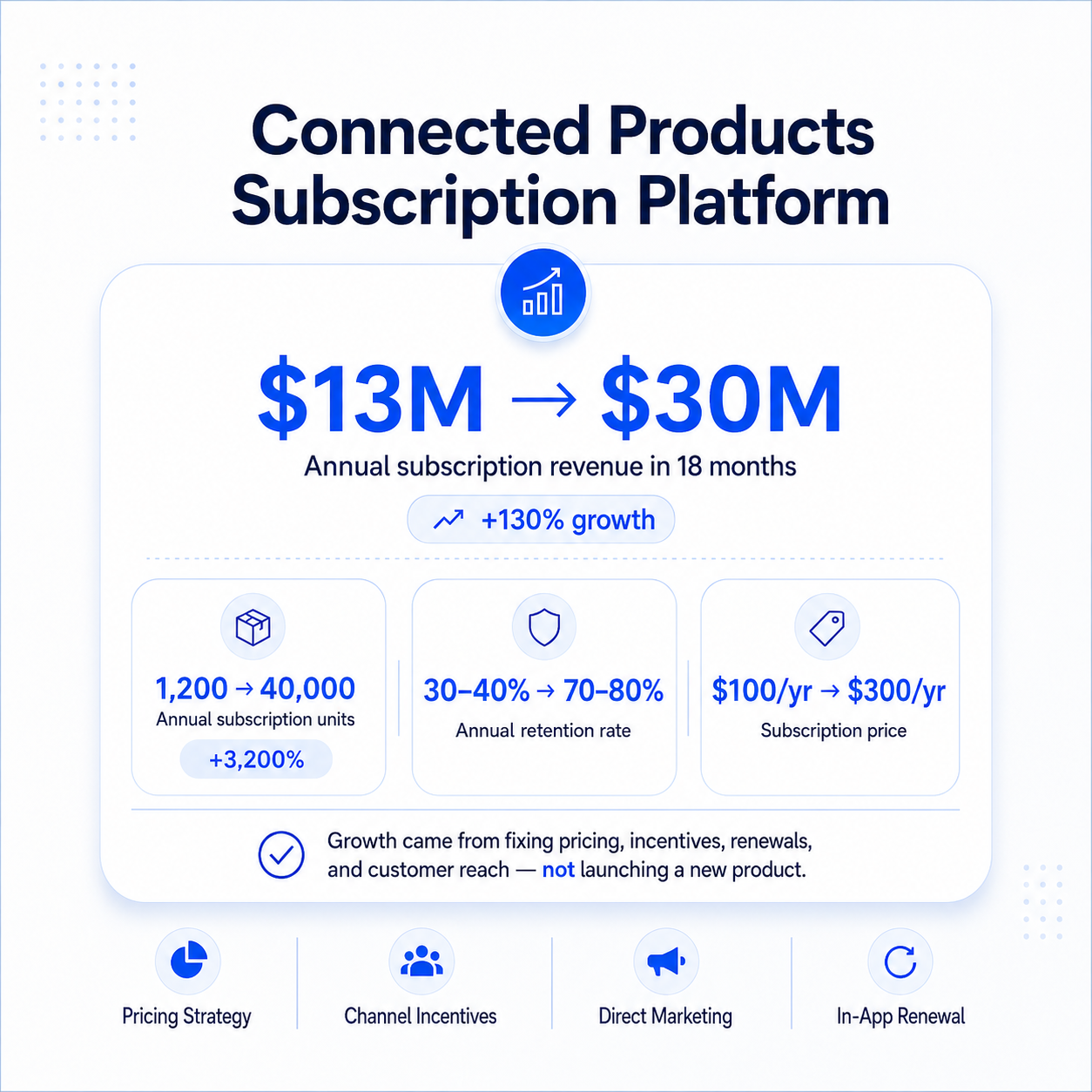
Subscription revenue growth chart — Connected Products Company
Smart Home

$13M to $30M in Recurring Revenue

+130% Annual Subscription Revenue
The Situation

A subscription business sat inside an 80,000-unit/year hardware platform — invisible to end customers, priced at $100/year, with 30–40% annual retention and no B2B incentive structure. Leadership knew it was underperforming. What they didn't know was how much — or why. Pricing hadn't been reviewed in years. There was no direct customer marketing, no in-app renewal path, and no channel incentive to actively sell subscriptions. The product hadn't failed. It had been neglected.

Key Outcomes
  • Price increase — $100/yr to $300/yr — with a restructured tier model and no market exit
  • 33× Take rate — from ~1,200 units/yr to ~40,000 units/yr via aligned dealer incentives and direct customer marketing
  • Annual retention — 30–40% to 70–80% after ERP integration and in-app renewal closed the churn gap
  • 18 mo From engagement start to $30M ARR — by fixing a neglected business, not building a new one
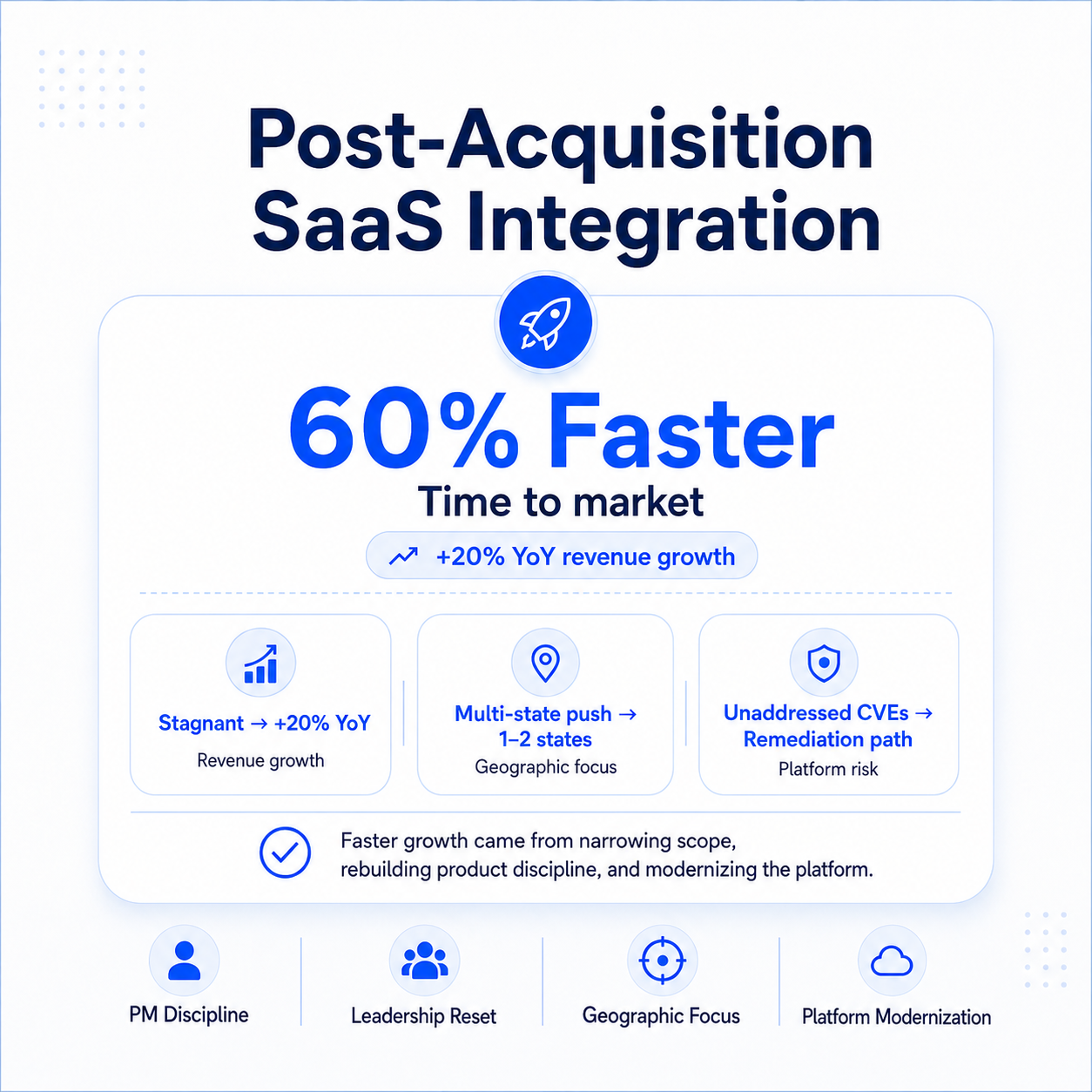
Delivery velocity and revenue growth chart — SaaS Post-Acquisition
Consumer Device Product Company

60% Faster to Market. 20% Revenue Growth. By Doing Less.

60% Faster Time to Market
The Situation

A $20M SaaS company made a strategic acquisition — a bolt-on product designed to expand their core platform into new markets. A year in, it wasn't integrating. The acquired product leader was making ad-hoc changes to engineering directly, with no formal process. Two teams had low trust and no shared workflow. Meanwhile, the company was pushing into multiple new U.S. states simultaneously, each carrying unique compliance overhead. And the platform itself was running on outdated infrastructure with cybersecurity vulnerabilities that hadn't been surfaced at acquisition. Complexity was compounding faster than capacity could absorb it.

Key Outcomes
  • −60% Time to market after replacing ad-hoc product ownership with disciplined PM — roadmap ownership, sprint cadence, clear engineering handoffs
  • +20% Year-over-year revenue growth by narrowing from multi-state expansion to 1–2 state focus — fewer markets, faster delivery, higher margin
  • ↓ CVEs Platform cybersecurity vulnerabilities surfaced and remediated — risk that wasn't disclosed at acquisition, now on a structured path to resolution
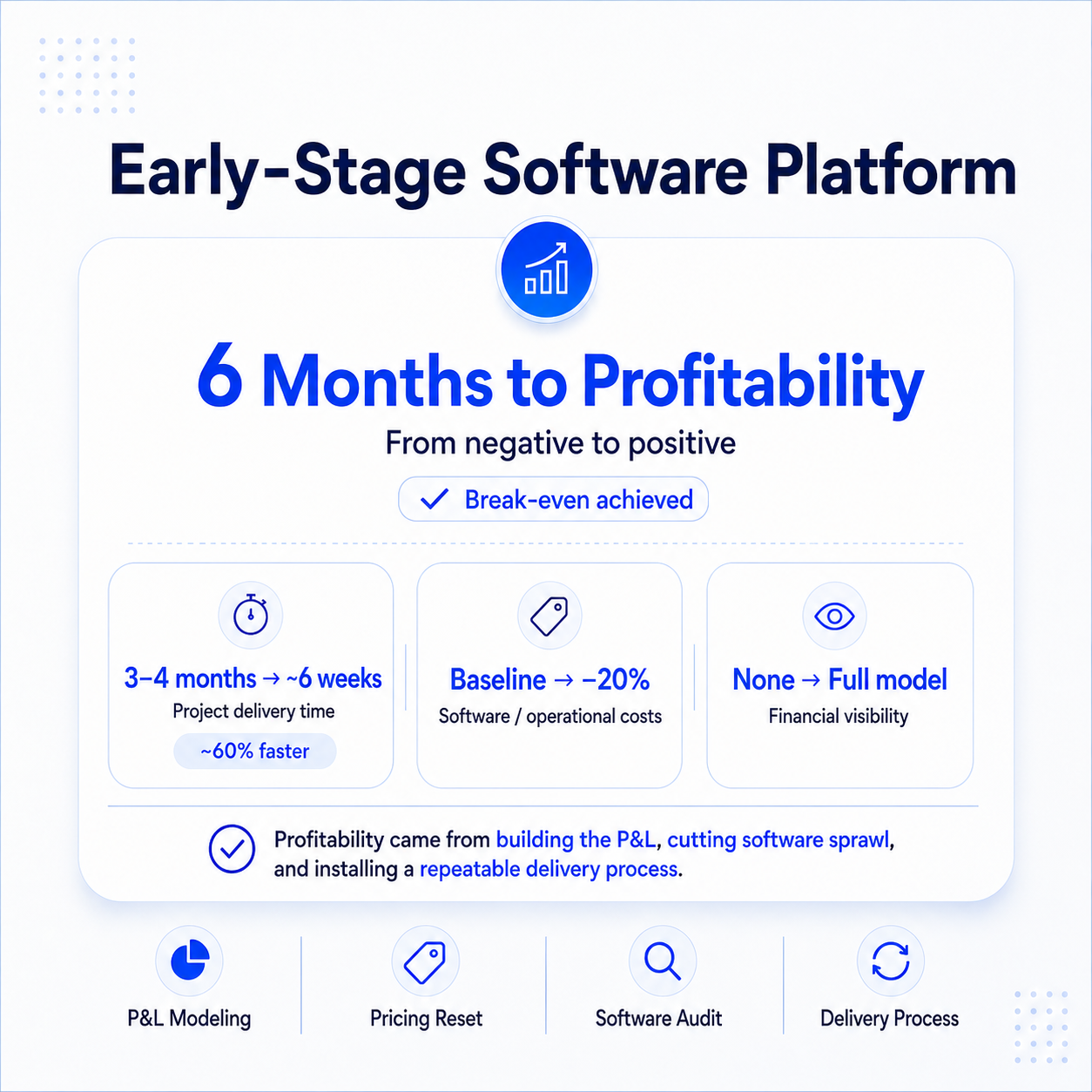
Profitability and delivery timeline chart — Early-Stage Software Company
SaaS Services Company

From Bleeding Money to Profitable — in Six Months

Profitable in 6 Months
The Situation

A $2–3M software company was losing money and couldn't see why. COGS was tracked as operating expense — which meant leadership had no view of where margin was going. Software spend had grown without discipline. Projects were taking 3–4 months to deliver. There was no P&L framework, no conversion model, and no way to connect software investment to business outcome. The company had a two-year goal to reach $10M in revenue. The path to get there was a hope, not a plan.

Key Outcomes
  • Break-even Reached in the final month of engagement — from ongoing losses — after P&L visibility exposed where margin was actually going
  • −20% Software and operational costs eliminated through a full stack audit — zero loss in output or delivery capability
  • ~6 wks Project delivery time — down from 3–4 months — after structured intake, scope management, and a repeatable delivery workflow replaced ad-hoc execution

All companies anonymized. Results available upon request.